
“…we have to learn how to say what is unsayable. We tell a story about violence to make sense of it, and the story returns to the public realm where grieving is possible. …naming the violence and grieving loss in community is how the hole turns into a wound that can heal.”
—See No Stranger by Valarie Kaur
Nothing causes theology to break down quite like suffering.
Years ago, I sat in a Sunday school class at church and listened to a member breaking our unspoken class norms by sharing his distress amid a crisis of faith. Something curious happened within me as he disrupted business as usual. At first, my intellect was offering theological counterpoints to each point of doubt he shared (thankfully, I kept these thoughts to myself). Looking back, I can see that I was trying to help ease his discomfort in the way that I knew how.
Then, the whisper of a thought arose: Listen to his pain. It seemed like the surface had been peeled back and I was able to hear the pain underneath his questions. That moment, perhaps made possible by my own recent season of suffering, forever changed the way I listen to those who are questioning the theology they inherited. Like most of us when we are hurting, he didn’t need theological answers, at least from me; he needed compassionate listeners to bear witness to his suffering and in doing so, to communicate that his pain mattered.
When people wrestle with foundational theological questions about how a loving God could possibly be said to be sovereign and “in control” as we witness such deep suffering in the world, sometimes what they’re really asking is, “Where is God?” or “Where was God?”
Martha said to Jesus, “Lord, if you had been here, my brother would not have died.” —John 11:21
Martha’s “Where were you?” when Jesus arrived after her brother’s death is implied by her statement. When Jesus saw Martha and others in their community mourning, his response, before his action (raising Lazarus from the dead), was to weep.
“Where are you, God?” and “Where were you, God?” are not questions meant to be met by intellect; they are expressions of lament. Sometimes what is called (or feared to be) blasphemy is actually lament.
Lament is a sacred practice that helps reorient our internal posture, by appealing to Someone/Something greater, when we can’t control external circumstances. It is preparation, not replacement, for action. Lament paves the way for clarity and unifies communities as we co-labor in the work of Love.
State-sanctioned violence has been embedded in our nation’s (U.S.) history since its inception. We are witnessing it now, certainly in the news, but also in our communities. It seems to be closing in on my local community, and each time I hear of an abduction, I call to mind the names and faces of friends and neighbors who belong to the targeted group. We all have to discern our individual role in participating in the work of Love in the world, and action is necessary. However, action is more sustainable and more clearly discerned when we continue tending to our inner work, which includes lament.
For me, feelings of sadness and anguish are usually delayed, springing up after the initial shock of moral injury. Oppression and violence affect us all, whether we are perpetrators, victims, survivors, or witnesses. One group cannot be oppressed and targeted by violence without everyone else being negatively impacted. We are all connected, as Martin Luther King, Jr., James Cone, Kaitlin Curtice, Valarie Kaur, bell hooks, Howard Thurman, and many others have articulated.
Recently, when the tears finally arrived during a recent time of prayer, I knew it was time to give myself space for lament. This Holy Week, may we take the time and space we need, individually and communally, to give voice to the injustices we are witnessing and the grief we are experiencing.
As we approach Good Friday, Christians around the world are remembering when Jesus cried out on the cross, “My God, my God, why have you forsaken me?”
Jesus wept, and so can we.
An invitation:
If you would like to join me in writing a lament, Brenda Salter McNeil shared this template that might be helpful. While I have framed mine in my context as a Christian (see below), you do not have to be a Christian, or even religious, to practice lament.
Lament for Our Neighbors
Creator of heaven and earth,
Maker of celestial bodies
and human bodies,
You have famously intervened
here on earth
many times before.
You have allowed free will
even as Your heart must break,
again and again,
knowing and witnessing the consequences
of allowing us to choose.

And yet,
while there has always been suffering,
there has always been resistance.
You have raised up prophets
in every generation
to speak the truth--
to say the unsayable--
and lead Your people to freedom.

Oh Lord, hear our cries!
The same breath that proclaims you “Lord”
cries out in despair at Your seeming inaction.
The number of “the least of these”
is growing every day
as earthly wealth and political power
are consolidated
again,
still.

Unwarranted violence is closing in
on our community.
Perpetuated—in Your Name!!—
against those who have come seeking refuge,
just like Jesus’ own family.
God, these are our friends and neighbors,
teachers and students,
members who keep our communities
vibrant and strong.
More, these are Your precious ones!
Each life, each family, each story
is not lost to You.

How long,
O Lord,
will they be targeted
by the schemes of violent men?
How long will we—
the survivors, victims, witnesses,
perpetrators, and architects of this violence—
suffer the illness of moral injury?

Give me courage and strength
to co-labor with You and others
for justice, for freedom for our neighbors.
Show us what to do,
and let us not be divided by infighting,
pride, or self-righteousness.

I confess I have seen the violence in me, too.
Root it out.
Forgive me.
Create in me a pure heart.
Let me be faithful to live in the way of Love—
to do justice,
love mercy,
and walk humbly with You,
my Lord and my God.
Resources
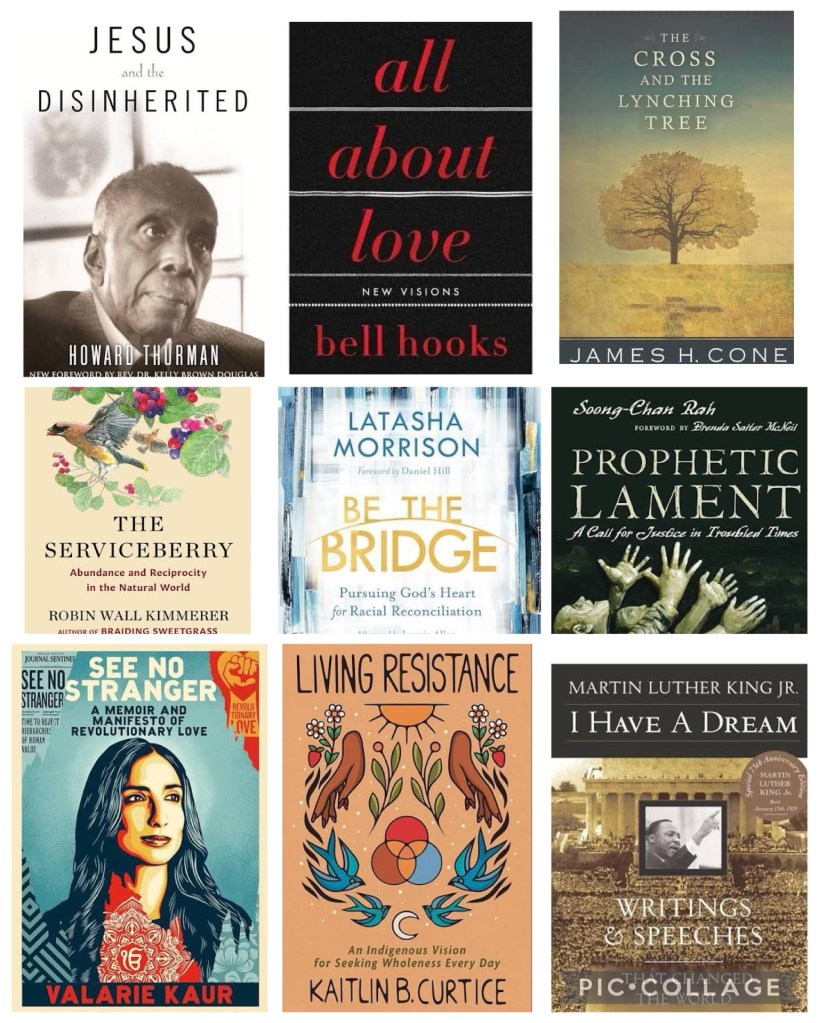
If you would like to read (or listen to) more on lament and/or the interconnectedness of humanity and creation, check out these resources:
•Prophetic Lament: A Call for Justice in Troubled Times by Soong-Chan Rah
•See No Stranger: A Memoir and Manifesto on Revolutionary Love by Valarie Kaur
•The Cross and the Lynching Tree by James H. Cone
•Jesus and the Disinherited by
Howard Thurman
•Be the Bridge: Pursuing God’s Heart for Racial Reconciliation by Latasha
Morrison
•All About Love: New Visions by bell hooks
•Living Resistance: An Indigenous Vision for Seeking Wholeness Every Day by Kaitlin
Curtice
•The Serviceberry: Abundance and
Reciprocity in the Natural World by Robin
Wall-Kimmerer
•I Have a Dream: Writings and Speeches by Martin Luther King, Jr.
• “The Need for Lament” – a short video with Soong-Chan Rah
 Lindsay L. O'Connor
Leave a comment