
on belonging, fragmentation, and integration: a pondering, a poem, & a practice
“If contemplation is about penetrating illusion and touching reality, why do we commiserate with others when they tell us about an experience that’s ‘disillusioned’ them? ‘Oh, I’m so sorry,’ we’ll say. ‘Please, let me comfort you.’ Surely it would be better to say, ‘Congratulations! You’ve lost another illusion, which takes you a step closer to the solid ground of reality.’”
—Parker Palmer, “Parker Palmer Explains Why Inner Contemplation Is So Necessary”
I’ve been seeing people (rightly) talking about the importance of community in working together for a more just world, but co-creating or finding and sustaining healthy communities is sometimes easier said than done. In the U.S., we are deeply embedded in a culture of hyper-individualism, which certainly affects the ways we interact in and experience community.
While there are many aspects of community to consider, I’ve been thinking about our relationship with belonging. When we don’t feel a sense of belonging in our communities, it is more difficult for us to offer the gifts we bring as our authentic selves as well as cultivate hospitable spaces for diverse groups to work together. Sometimes before we can find a sense of belonging with others, we have to come home to a sense of belonging with the Self.
“Am I really that different from everyone else, or does everyone else feel this way, too?” This was among a few pressing questions I was asking some years ago while on a walk. I had been struggling to find communities where I felt like I could be myself and had begun to wonder if I was the common denominator in the problem of my search for belonging. Over the years, I have asked many variations of the core question, Is it just me? Learning to trust my own experience of God and of life continues to be part of my life’s work as an Enneagram 6, which means I have a habit of looking outside of myself for validation of what I already know but don’t trust.
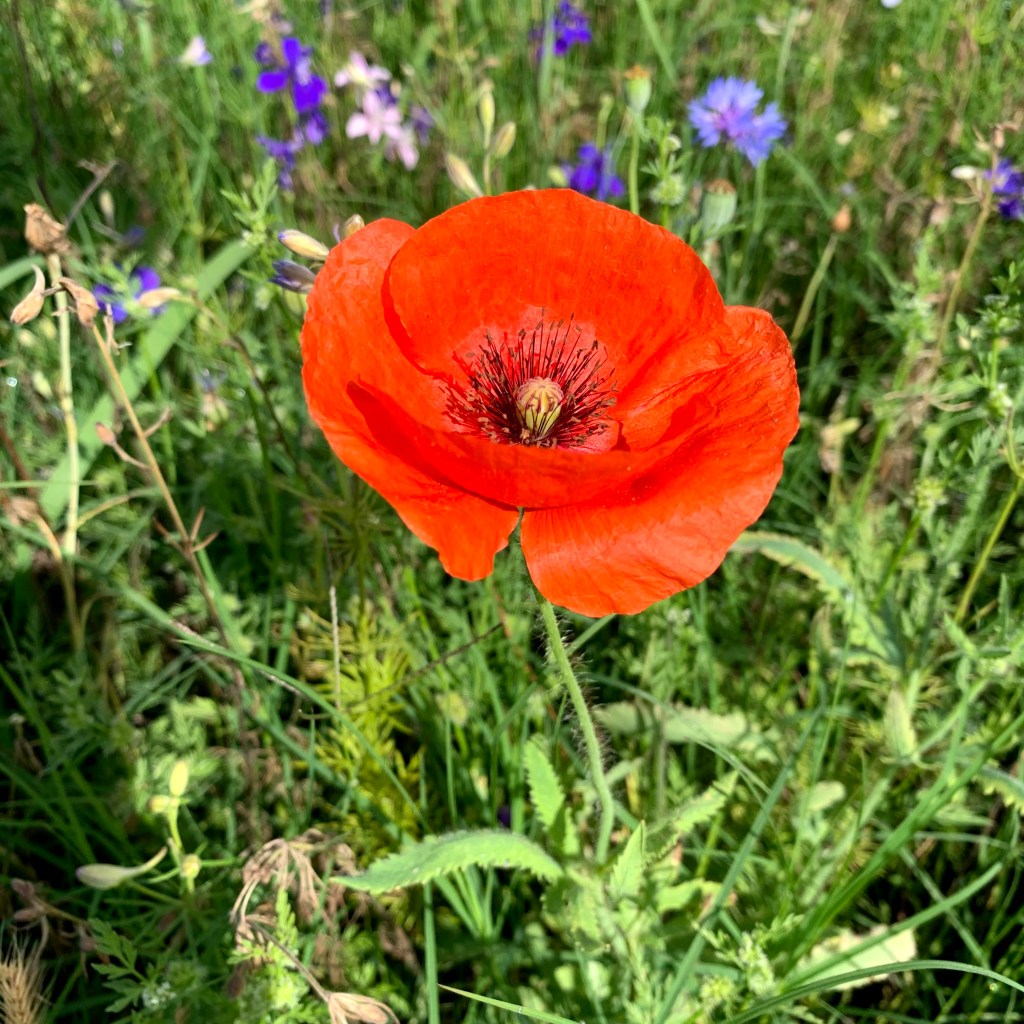
As I pondered and prayed, I lifted my eyes and my gaze was met by a field of wildflowers. My attention was quickly drawn to a lone poppy, bright red against a backdrop of powdery blue cornflowers and soft green grass. A question surfaced in my mind: Does that poppy belong?
The question seemed absurd. Of course it belonged. How could a wildflower not belong? Then the question was followed by this thought: It belongs because it is there, and that is where it grew. The poppy had done nothing to achieve belonging other than simply growing where it had been planted by forces outside of itself. The fact that it stood out didn’t mean that it didn’t belong.
I wondered what it would feel like to stand out and yet still belong.* What would it mean to belong to myself so that I didn’t rely so heavily on others to help me feel accepted? What if my belonging didn’t depend on the feedback I was receiving (or perceiving)? I used to assume, on a subconscious level, that belonging required me to give up pieces of who I was, to “read the room” and adapt (hello, Enneagram 3 energy). This became an exhausting way to exist in the world. At midlife, I’m beginning to think that part of the process of maturing happens simply because we run out of energy for all the ways we’ve worked so hard to keep it together.
Reading the room and adapting has its place, but when it becomes an automatic response, over time, it can leave a person feeling anxious, worn out, and disconnected. Fitting in may keep the pain of rejection at bay initially, but eventually, the deeper parts of ourselves that have been hidden away long to be seen and loved. The surface-level connections we make based on excessive conformity to the group end up feeling shallow and unfulfilling. When we don’t allow ourselves to be seen, we miss out on the connection and intimacy that are only made possible in conjunction with authenticity. The true self we hid for decades may begin to seem elusive even to ourselves so that we don’t know where to begin in the quest for authentic reconnection with our true selves, let alone with others.
Nothing is more human than the core desire for belonging, and people try to satiate that desire in many different ways. Like the title of this lovely book from Sesame Street says, We’re Different, We’re the Same (by Bobbi Kates and Joe Mathieu). Some of us try to hide, withdraw, or minimize our needs, while others find safety in blending in with the group. Some lead with their deepest insecurities so they can know right away if they will be rejected, and some assume from the start that they will not be accepted and act accordingly. Some try to exemplify the best and most successful version of the values they perceive are held by the group, while others work hard to make themselves indispensable. Enneagram work can highlight our typical patterns and point toward a path for transformation and healing.
Connection is so essential to human survival and flourishing that we develop these sophisticated strategies to protect ourselves from disconnection. Often, these strategies are quite effective until one day, we realize the coping skills we developed to avoid rejection are actually the obstacles that keep us from authentic connection. The armor we constructed is doing more harm than the threats against which it was protecting us.
When this realization occurs, we are on the precipice of transformation. This is difficult and ongoing work, and it can be helpful to have the support of a therapist, sponsor, spiritual director, or other guide who is trained to hold the compassionate space that provides the safety for us to begin practicing letting down our guard.
Like most deep work, this is often best done a little at a time, at a pace and in a context that feels tolerable, beginning with low-stakes situations. Below, I’m sharing a poem as well as some reflection prompts that may be helpful in connecting with your authentic self.
*There are certainly situations when we are in a place/community/relationship that does not offer the safety necessary in order for us to be our authentic selves; not everyone has earned the privilege of having access to your full, authentic self. Sometimes we need our coping strategies, and sometimes we need to leave harmful environments, groups, or relationships. This post is addressing a general feeling of not belonging in a space that is not harmful, but it’s important to acknowledge that not all places/communities/relationships are safe, beneficial, or desirable for all people. It’s also important to distinguish feeling unsafe versus feeling uncomfortable. Discomfort is not always harmful (and is sometimes necessary in the process of healing and growth), but being unsafe is.
Poetry
This is Why It Hurts

Did it hurt,
the first time you gave yourself away?
Did it sting,
when the little pieces splintered into fragments
that you wished you could take back,
offered up like candy on the altar of broken relationships?

Unaware, perhaps, of the crime you were committing,
you were focused on perfecting that disarming smile.
Their weapons came down
as they smiled and took the piece of you
from your bleeding, outstretched hand
before continuing on their merry way.
(That was before you learned how to bandage the wound.)

Did it hurt,
the first time you made yourself so small?
Did it pain you,
maintaining the smile, trying to make it say
all that you thought it needed it to?
Their reactions—so helpful!—
told you how it could be tweaked.
Soon it was not just your smile
but your whole entire body
contorting into
Acceptable
Shapes
and Sizes.

Did it hurt,
the first time
you told yourself the truth?
Did it ache
when you became aware,
watching yourself as though
you were observing someone else
commit the crime you had committed
countless times before?

One day you paused from all your work
and in the silence,
                        stillness,
                                    solitude,
the face of God was like a mirror,
your fragmented reflection gazing back,
wide-eyed, anxious, and bewildered.

“This is why it hurts,” the Whisper said
as your eyes took in all the fractures.
You saw how you’d been pulled apart
and now felt yourself held together.
“Let us meet again.”

Each meeting brought the mirror.
Studying it was like confession:

“O God, please forgive me.
I knew not what I was doing.”

After a time,
many meetings later,
someone approached you
with an outstretched hand,
as you had trained them to do.
But this time, just as you began to reach mechanically
to break off another fragment,
you thought of the bewildered reflection
and the Whisper of a thought stopped you:

“Maybe,
just this time,
you don’t have to give yourself away.
What if,
just this moment,
you stayed with yourself?”

Maybe the sum total of your ‘not enough’
doesn’t preclude you from being loved
as you actually are—
not as you could be or should be
or will be,
some day.

Did it hurt,
the first time you resisted?
Did it sting
the first time
you let your whole fragmented self
be held, loved, and free,
just as she actually is?

You are already called “Beloved.”
Let
yourself
be loved.
Practice
These are some journaling prompts to help you connect with your authentic self. Feel free to focus on the ones that resonate most and skip the ones that don’t. As always, go at a pace that feels right for you, and if you begin to feel overwhelmed, take a pause and consider finding a therapist or spiritual director to support your work.
- What strategies have you used, consciously or unconsciously, to find belonging? Some possibilities: hiding or withdrawing; reading the room and adapting to the group; leading with your insecurities and vulnerability; assuming you will not be accepted and leading with “moving against” energy; working hard to be helpful and indispensable to the group; striving to become the most successful version of the group’s ideal
- When have the strategies you listed above been helpful? When have they not served you well?
- What places, communities, or relationships have not earned the privilege of having access to your full, authentic self? How have you, or could you, set boundaries to protect yourself when needed?
- How do you feel about the ways you have tried to fit in and/or stand out?
- When have you felt like your most authentic self? Consider who was present (if anyone), where you were, and what you were doing. What did it feel like?
- Finish the sentence: When I think about belonging, I feel ______.
- What’s something about yourself that you’ve felt you had to hide, repress, minimize, or “tone down” in order to belong? What has happened (or do you fear would happen) when you didn’t hide this part of yourself?
- Imagine the feeling you labeled in number 4 as an image. If you could describe that feeling, what would it look like? What would it say to you? How would you like to respond?
Offer gratitude for all the parts of yourself that have worked so hard to protect you. As you breathe in and out slowly, imagine waves of love and compassion covering each part of yourself.
 Lindsay L. O'Connor
Leave a comment